
TRANSFORMATION & CRISIS · WORLDMEDIAFESTIVALS 2026
In cinematography, we often speak about "depth of field." We choose what to keep sharp and what to blur in the background, creating accents that guide the viewer's attention. Before February 2022, my creative process as a director, screenwriter, and head of NGDS.Design was focused on the pursuit of ideal aesthetics, technical excellence, and the grand scale of industrial storytelling. I worked with major corporations, capturing the raw power of oil extraction and the vastness of mining complexes.
But the war forcibly reset my "camera" settings. On February 24, 2022, as bombs and missiles began to fall on my country, all previous filming plans lost their meaning in a single moment. When the reality around you starts to literally crumble, everything secondary – glossy frames, complex staged effects, artificial marketing trends – instantly blurs and loses its value. Only one thing remains in focus: the human being and their resilience. Reportage documentarians who found themselves near the front line began recording events immediately – often at the cost of their own lives. I was not among them. My path was different and longer: from confusion to the realization that a camera can be more than just a means of production; it can be an instrument of resistance. This transition from "cinema as a glossy industry" to "cinema as a way of preserving memory and documenting the reality of a nation and its people" took long months and became the primary vector of my creative transformation.
Recent years have fundamentally changed my approach to documentary and social content. I used to look at subjects through the lens as a professional searching for the "right angle." Now, I see them as a part of the nation's destiny, our people's fate, and even my own. Working on the project "The Unconquered: Voices of Veterans and their Partners," I realized that the role of a director in times of great trial is not just to record events. It is the role of a conduit, helping difficult experiences, hope, and dignity find a voice that the world can hear.
I have learned to wait and to listen. In war, time is a resource you do not control. But in interviews with veterans, time is one of the most vital tools for building trust. Only silence and time allow heroes to remember and tell the unvarnished truth. When you film people who have traveled such a difficult path – one impossible to even imagine – yet kept their dignity, you have no right to the habitual "director's gaze." War taught me radical sincerity: the best shot is the one where the author's presence disappears, leaving the viewer alone with the subject's truth. This shifted my creative ethics; I no longer seek an "impressive image," but rather that moment of the story, vital to the hero, which etches itself into the viewer's memory without any special effects.
This approach requires immense emotional resources because you aren't just filming – you are living each story alongside the hero. But it is this authentic, unretouched truth that carries the greatest weight today.
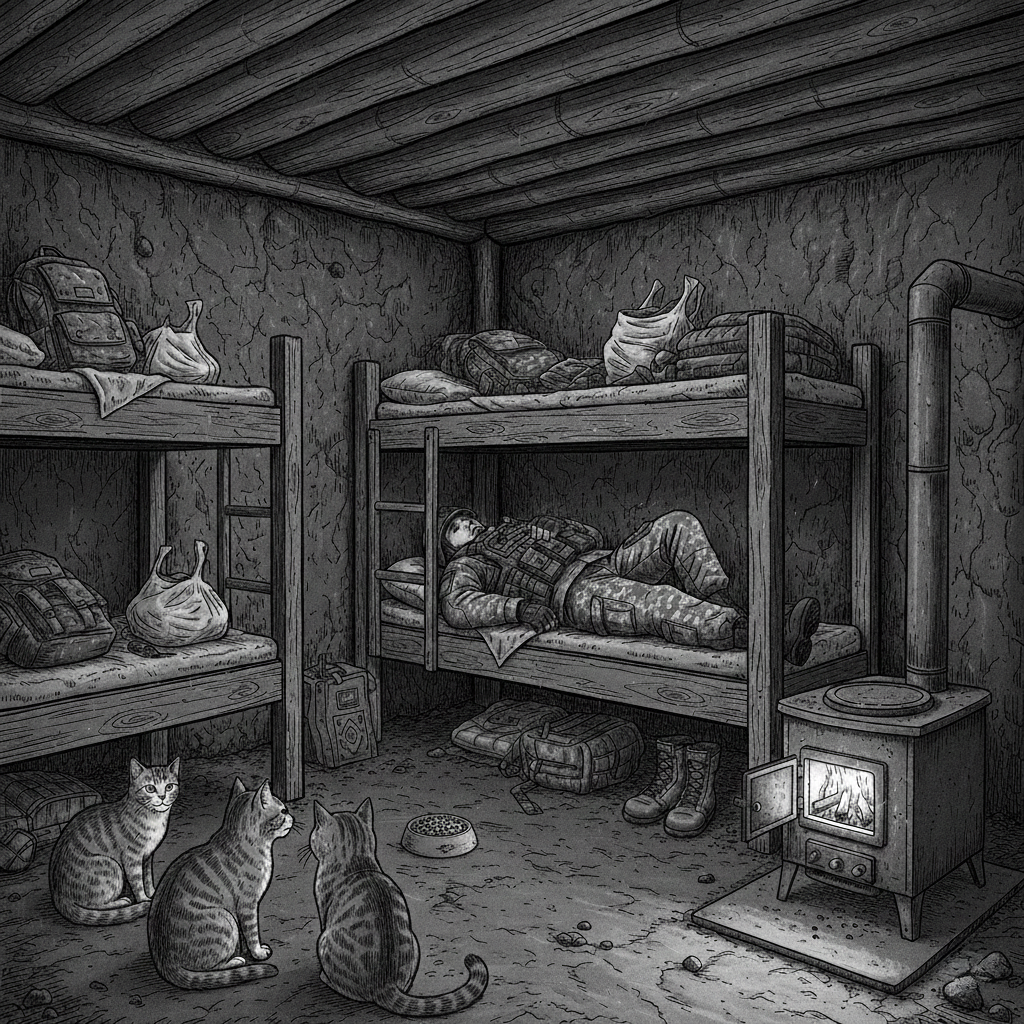
Even before 2022, I began integrating Artificial Intelligence into the studio's work as a tool to speed up raw material processing, editing, and post-production. After the war began, AI became part of my work not as a technological trend, but as a response to a specific problem: what to do with memories that were never captured. In conditions where the enemy seeks to destroy not only people but our memory, history, and culture, technology becomes an instrument of resistance.
For me, generative models are not a replacement for live filming, but a way to show what can no longer be filmed. Many times, I have asked veterans, "Can I see the photos or videos you took back then?" and heard the reply: "The phone stayed behind in some tree line where I was wounded." Perhaps it was crushed by an enemy tank, perhaps it flew into a puddle after an explosion, or perhaps medics left it behind in torn clothing during an evacuation. Therefore, animating still frames, reconstructing and restoring lost details, and creating visual metaphors where physical filming is impossible is my way of fighting for memory. If we do not restore these images, they will exist nowhere. That is why in "The Unconquered," we use generative tools not for effect, but for wholeness: so that alongside the veteran's living face, the viewer can see what remains only in their memory.
Observing the global media community from within the Ukrainian context, I see a significant evolution in how cinema is perceived. Alongside technically perfect productions, audiences and the festival community are increasingly turning to documentary and auteur cinema – to films where a palpable urgency and the author's honest gaze are felt behind the frame. We live in an era where authenticity with scars is valued much higher than perfect digital retouching.
My perspective on the industry has become more global yet more focused. I realized that a local story from Kharkiv, Poltava, or Mariupol becomes a universal language if it touches upon deep human feelings: choice, loss, love and devotion, and even death. This is understood in Kyiv, Berlin, and Toronto alike. Today, creators are seeking "realness" that cannot be imitated in a sterile studio. We are moving away from the era of big budgets toward the era of big ideas and personal responsibility. War has forced me to answer the question "Why am I doing this?" every day, making my creative voice clearer and stronger.
Creativity during war is not a luxury or an escape from reality. It is an act of will. It is a refusal to be merely an object of tragedy and a choice to remain a subject who creates, builds, and inspires. Every work we release now is not just a creative result. It is a testament that even in war, one can maintain professional dignity and speak to the world as an equal.
War has taught me to value every second of filming time. We film during air raid sirens, knowing that the best light is the light we have right now – because there may not be another chance to shoot. My message to directors around the world: do not wait for "ideal conditions" for your masterpiece. Create now, amidst chaos and uncertainty. Use the most modern tools – from the latest cameras to AI – to tell eternal stories about human character. At the beginning, I wrote about "depth of field" – about the choice of what to keep sharp and what to blur. War made that choice for me. It removed everything unnecessary and left only one thing in focus: the person, their memory, and their dignity. Now, I film not to impress – but to preserve and tell. And that is perhaps the most precise camera setting I have ever made.