PUBLIC RELATIONS & REPRESENTATION · THE WORLDMEDIAFESTIVALS 2026
After 20 years in public relations, I remain as determined as ever to help reconnect our industry with its core purpose – to represent and relate to the public. In the UK in particular, I often notice familiar campaigns returning, with essentially the same homogenous voice, the same tone, and the same idea repackaged. When multiculturalism is portrayed, it feels watered down to a point where it misses the communities it’s meant to serve.
That feeling is backed up by statistics, with surveys and reports showing that representation in UK media is in fact remarkably unrepresentative – and if teams are not reflective of the society we live and work in, then our media and creative work will mirror those limitations.
A CIPR report on the PR industry in the UK found that the sector remains predominantly White, at 87% in England and Wales, and 93% in Scotland. When we look at UK representation in TV and film production off- and onscreen in 2022, representation is likewise extremely low. Offscreen (people working in creative production roles), 5.8% were Mixed, 4% Black, 2.4% South Asian, 1.1% Other and 0.6% East Asian. Onscreen 7.7% were Mixed, 8.1% Black, 4.9% South Asian, 1.5% East Asian and 1.1% Other. In 2025, while the numbers have improved, we are still a long way from realising the multicultural nature of our society – both commercially and in terms of identity and belonging.
I believe public relations has a responsibility to build bridges to foster true representation across the media landscape. Because we work closely with journalists and the public, we have to be honest and authentic in all we say and do. We have to substantiate our words with evidence.
This means that, when we widen the frame and bring in more cultural and socioeconomic perspectives, the stories feel truer, travel further, and resonate with more people. That’s the opportunity that excites me.
As a British-born Punjabi Sikh woman, I have been on the front lines pushing for representation in the media and content – both with clients and within the agencies I’ve worked for. Having lived in France, Japan, the UK and most recently India (Punjab) and being able to speak the languages of those places has given me a deep empathy for people from different backgrounds. My Kenyan-Indian heritage enables me to notice things many of my peers may miss – not for lack of experience, but because they are bound by a blueprint that sidelines multiculturalism and heritage as creative engines. I often find myself pushing for openness to a society that isn’t one dimensional, but multicultural, multilingual, multiethnic, and socioeconomically diverse. When you commit to getting this right, it connects people regardless of age, gender or background.
The truth is, we all possess heritage and culture. Most of us have travelled, listened to other languages, and observed how people interact elsewhere. Yet we live in a society still shaped by colonialism, so we have a responsibility to create content that normalises “immigrants” as people, not exceptions. It still jars to be labelled an “immigrant’s child”, while a white British person in India or Africa is considered an “expat”. Language shapes identity, belonging and culture; it can prevent people from being othered. Multiculturalism should be a part of everyday life. When it’s treated as an add-on, it slides into tokenism.
That’s why it concerns me when a single person of colour is cast as a stand-in voice for multiple cultures. It is unfair to place upon one person’s shoulders the burden of representing the lived experiences of so many, within an otherwise homogenised creative workplace. I have also seen colleagues who are outwardly diverse – in appearance or accent – self-censor until they’re assimilated into a system that devalues their experience and culture. They adopt the same voice as their peers, rather than one reflective of the society we live in, or of their lived experience at home. When I speak with them, they’re often too exhausted to push back and shift workplace thinking and discourse.
It takes real courage to not become bound by the system; to stand in your truth and your heritage, and to continue pushing communication boundaries through the concepts and content you create.
So why is this so hard? And why isn’t PR leading the reframing of the creative narrative to reflect the society we live in?
If we are going to embrace big agency platitudes about accepting everyone and celebrating diversity, our content has to show it. But a look at recent creative campaigns shows it doesn’t, and that leads to PR cultural disasters. Take, for instance, Sabrina Carpenter’s faux pas with Arab culture; the backlash over the Taj Mahal necklace worn at the Wuthering Heights movie premiere; or the Barbie social media campaign that trivialised the atom bomb to tether two film releases – one bearing profound historical trauma for a country still living with nuclear fallout, and the other a pink satire of patriarchal toxicity. They do not gel. These failures are a product of homogenous creative teams who are not only historically uninformed, but culturally tone deaf.
To avoid such calamities requires centralising PR; making it the strategic hub from the brief, outward. Centralising PR defines audience cultural context, sets the messaging architecture, and, with the right team, brings in multiculturalism early. The creative life of a campaign is shaped by that audience insight, tone and risk awareness. Success is measured not by impressions, but by sentiment, multi-community reception, relationships and longevity.
While it is true that fully embodying these principles requires teams to broaden their hiring pipelines, even less diverse teams can design more perspectives into their process. This requires starting with a cultural brief that sets audience context and widens research to include minority and community channels. I’d also recommend incorporating cultural reviews at the conceptual and pre-launch phase, to ensure tone and language are shaped upstream. And stay curious: keep track of whose feedback changes the work, and actively invite dissent before decisions are locked in.
When you centralise PR like this, authenticity follows. Which is why I put these principles at the heart of every client campaign, and build multicultural teams that reflect society, bringing diverse socioeconomic backgrounds, varied life experiences, and a foundation of empathy, openness and curiosity.
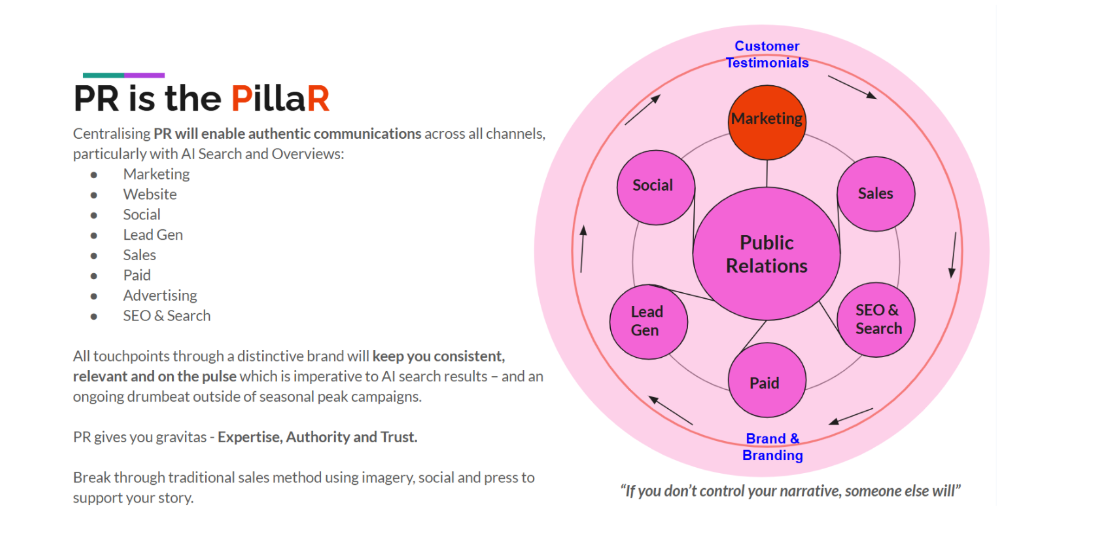
Authenticity isn’t a given; it’s earned by teams that positively challenge the work for perspective. It may take longer, but it’s far less likely to end in a cultural crisis or a brand cancellation. And culturally informed campaigns garner deeper, more durable loyalty. For anyone in the creative industries, be it film, TV or communications, it is essential to choose a team that fully understands intersectionality, cultural nuance, and the need for seamless, cross-channel communications.
My sincere wish is for the UK creative industry – along with the global industry – to fully embrace the rich heritage of the people who make up each society. In the UK, the Indian diaspora is the largest community after White British, yet fewer than 5% of PR professionals are of Asian (including East Asian) origin, and just 3% are Black (CIPR Research 2025). And when you factor in gender, age and socioeconomic background, the representation gap widens still further.
I launched Sakura London to ensure that representation wasn’t just an afterthought and, eighteen years on, Sakura London embeds representation at the heart of every campaign. Here’s a campaign we delivered about the on-demand workforce in the US and educating the public on the diverse group of drivers’ and their entrepreneurialism – transforming the role of a “cabbie” to a self-employed person in control of their lifestyle. The campaign garnered over 30 pieces of international coverage in Tier 1 media because it told a story about on-demand insurance through the lens of multiculturalism. Today, this work still facilitates ongoing investor, sales and customer communications. PR, through a multicultural lens, was centralised to bring real, and proven, authenticity and integrity to a high-growth brand determined to support representation in their industry.
If you make the work look like the world we live in – through culture, heritage and class – the world will answer back.